

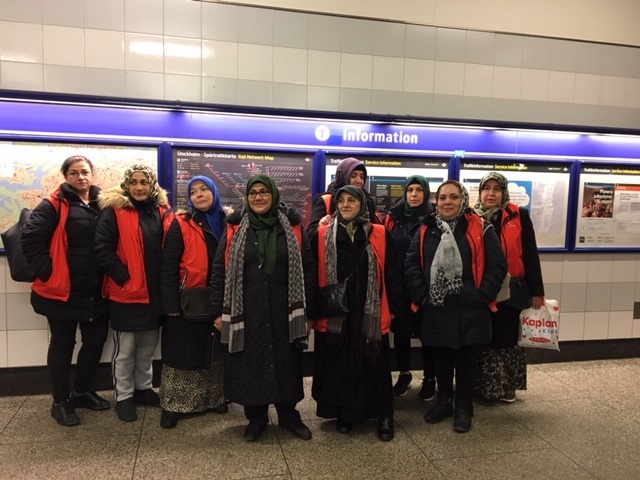

Fittja, a suburb southwest of Stockholm’s city centre, has experienced elevated levels of crime for decades, with gang violence prominent from the 1990s. It is one of Sweden’s so-called ‘especially vulnerable’ areas, a designation given to neighbourhoods characterized by an above average crime rate that can affect the local population.
In mid-December, a man was shot and injured in the leg, not far from the local tunnelbana (underground) station, which contains a sculpture showing a gun with a knotted barrel.
This artwork, a global symbol for non-violence, is one of the first things residents and visitors see when they arrive in the neighbourhood. The Local joined Ipek on one of her Friday evening patrols, together with eight other mums, most of them Turkish.
After a planning meeting held over traditional Turkish roasted chestnuts and strong Swedish coffee, we headed into central Fittja before beginning the route through the shopping centre, residential streets, and community gathering places.

“Stop, you can’t do that,” Ipek sternly tells one man standing by the Lidl supermarket who is apparently drunk.
His friend apologizes, promising to look after him, and she moves over to compliment a group of young men on their smart attire in suits and ties. They are meeting to go to a friend’s wedding, and promise to invite Ipek to the next such event.
When asked if she knows a lot of the young people here personally, Ipek smiles broadly. “Oh yes! They help me, if something happens; they support me,” she says.

During the almost one-hour walk around the neighbourhood, groups of teenagers stop to ask the women how they are and to offer hugs to Ipek, who also cheerfully greets local business owners. The mums pass by the neighbourhood’s Diversity Centre and Ungdomens Hus (a community centre intended to offer social and leisure activities to young adults in the area), and into the local school, which is still open and serving food and drinks from the canteen.
“We aren’t looking out for anything special,” one of the women explains as Ipek chats to a few youngsters she knows in the canteen. “If we see anyone fighting or arguing, we call the police. But I’ve been doing this for five months and I’ve never seen anything.”
So how does it feel when she’s out on weekend evenings? “I feel happy. Very, very happy.”
“It has helped me become integrated in the Swedish culture,” she adds. “I like being a part of it; it feels good to be out and to gather together and walk.
(thelocals.se)
This explanation highlights the dual role of the walk. The presence of adults is intended to set a good example to youngsters and potentially help de-escalate and troubled situations, but it’s also a way for women in an area with a high proportion of immigrants to meet each other and gain some independence.
Residents of especially vulnerable areas are more likely to feel unsafe when out in their neighbourhood at nighttime, with 38 percent saying they felt unsafe at night in comparison to 27 percent in other urban areas of Sweden, according to a report by Sweden’s National Council for Crime Prevention, Brå.
Among women, the figure was even higher. Over half said they felt unsafe at night.
Ipek is also working on organizing Swedish and English courses for the women, many of whom moved to Sweden as adults and have spent much of their time at home, making it hard to learn the language. These classes are aimed at giving the mothers more opportunity for involvement in local community life, as well as boosting confidence.
She has also travelled around the country sharing some of the lessons her group has learned – and their successes. Last year, she was named Sweden’s Trailblazer of the Year at an awards ceremony held by Aftonbladet, one of the country’s largest newspapers, for setting up her group of all-female ‘night-walkers’ four years ago.
A similar group of mothers now patrols the streets in Rinkeby, another area designated as ‘especially vulnerable’ by police in the north of Stockholm, and earlier this year, a mothers’ walking group was launched in Sofielund, Malmö.
“There have been a lot of problems in Fittja, but children and young people have told me it feels safer and calmer now. I just want to help children and to help Fittja; people have moved to Sweden to build their lives here and we want people to feel safe in their neighbourhood,” Ipek tells The Local.
